
High Temperature Un-Cooled Extensometers (700 °C) – Model 7642
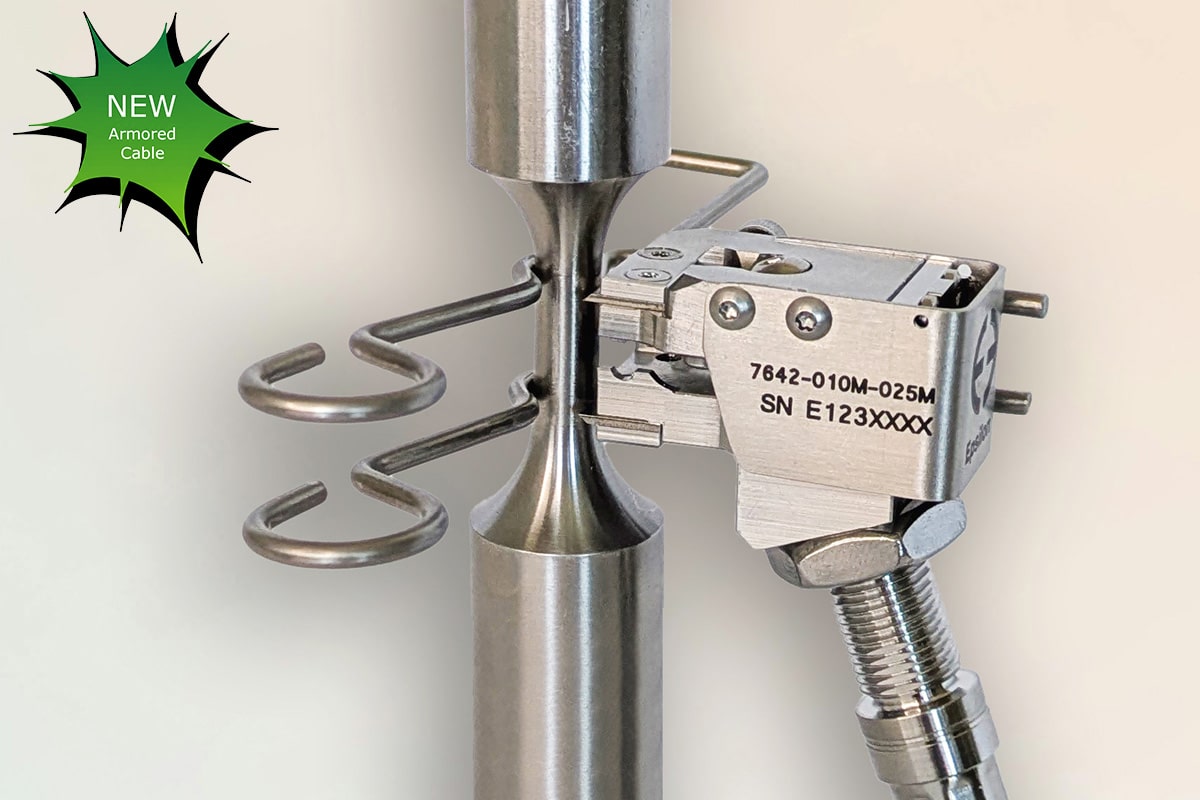
Gen3 Product
The Model 7642 INTRODUCES SEVERAL IMPROVEMENTS to Epsilon’s offerings for uncooled axial extensometers:
- Optimized cross flexure body and probe design provides lower noise, better frequency response, and improved durability
- Weight and size are minimized
- Increased operational temperature
- Ability to store multiple extensometer calibrations with one signal conditioner
- Armored high-temperature cable
WITH OVER 30 YEARS OF SERVICE
to the materials testing community, you know we will be there to stand behind our products when your critical application requires it.
These extensometers use a high-temperature capacitive sensor and do not require any cooling. They will operate up to the maximum temperature limit of most environmental chambers used in materials testing. Model 7642 is ideal for elevated temperature testing of metals, composites, and high temperature polymers. All configurations can measure in both tension and compression and can be used in closed-loop strain control. Model 7642 may be used for monotonic tension or compression tests as well as cyclic fatigue tests such as low cycle fatigue (LCF).
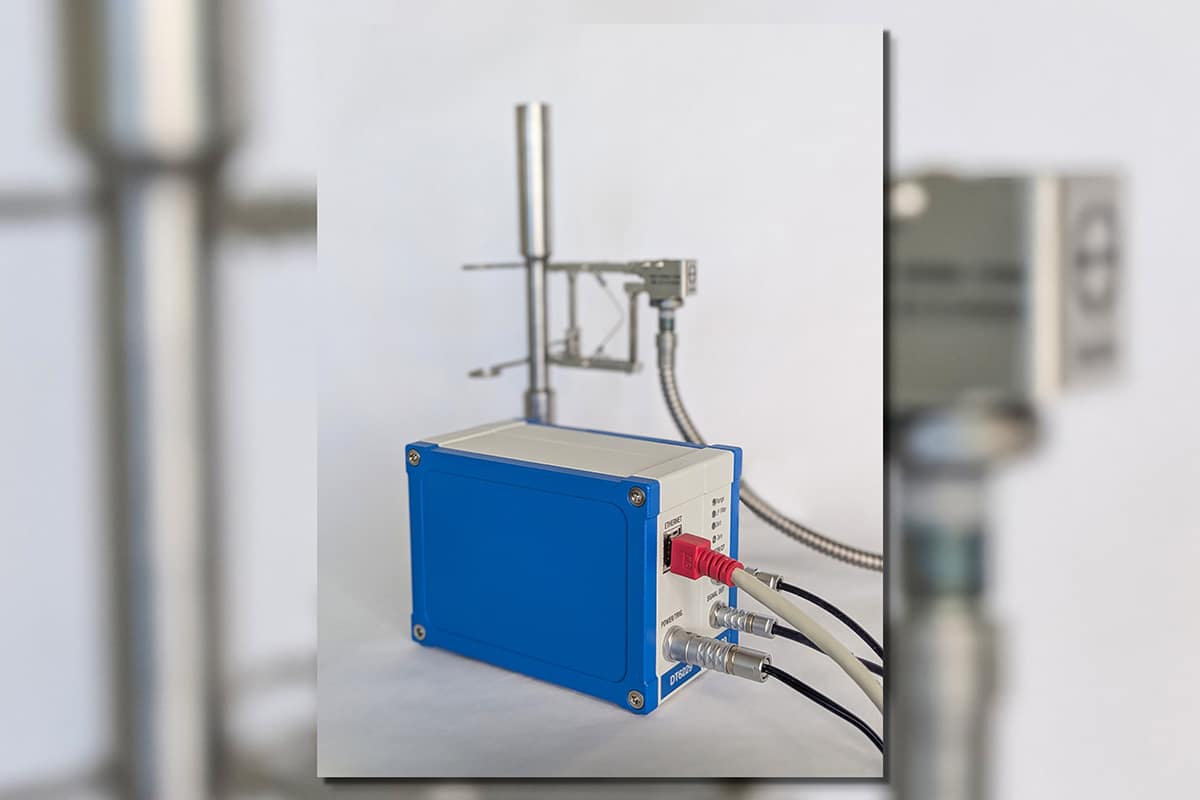
The extensometer is supplied with the advanced DT6229 controller. The standard output is a ±10VDC analog signal, factory calibrated with the extensometer. The controller also provides a high-speed digital output, built-in calibration and tare functions, and filters.
The 7642 is readily interfaced with most testing machines and may be directly connected to a data acquisition system or a PC.
- May be left on through specimen failure.
- Excellent accuracy and low noise performance at high temperature.
- Minimal size and weight, and high frequency performance up to 100 Hz.
- Optimized for noise rejection.
- Digital controller and power supply included. Provides high level DC voltage output with low noise. Easily interfaced to test controllers and data acquisition boards.
- Includes high speed analog and digital outputs
- Intuitive web-based user interface for setup, calibration, and data acquisition
- Built-in calibration reference and auto-zero features
- Multiple extensometer calibration files may be loaded for use with one controller
- Multiple temperature-specific calibrations may be stored
- 11-point linearization
- Selectable analog and digital filters from 2 Hz to 3 kHz
- Extensometer and electronics ship fully calibrated (traceable to NPL). Full scale output voltage may be user-specified when ordering (typically ±10VDC).
- All models can measure in both tension and compression and may be used in closed-loop strain control as well as for cyclic testing.
- Built-in mechanical stops prevent overtravel.
- Rugged, dual flexure design for strength and improved performance. Much stronger than single flexure designs, this also allows cyclic testing at higher frequencies.
- Hardened tool steel knife edges are easily replaced. A spare set comes with every extensometer.
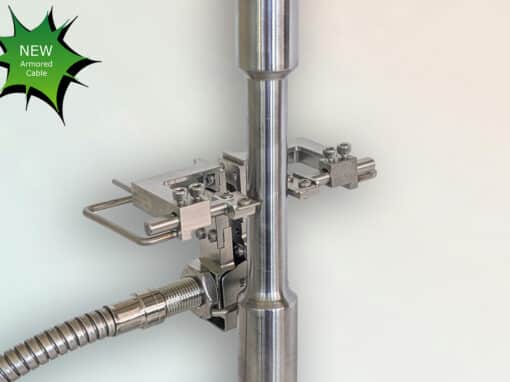
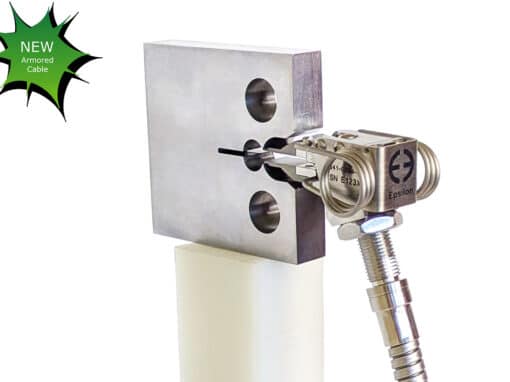
- Rugged, long-lasting high-temperature cable is armored to prevent kinking and pinching.
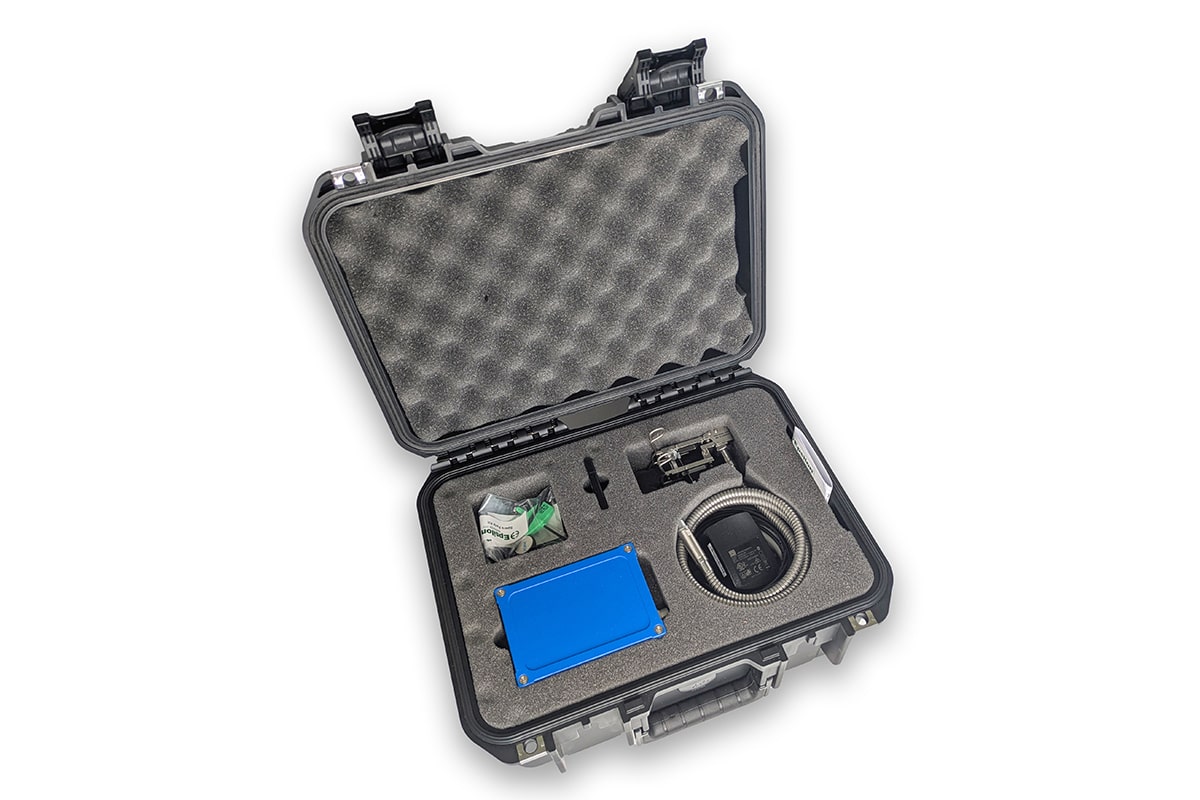
- Includes a high-quality foam lined case and a spare set of knife edges.
Analog Output: User specified, typically ±5 VDC or ±10VDC; ±10.8VDC rail
Digital Output: 24 bit high speed Ethernet output with built-in web interface
Accuracy: Standard configurations meet ASTM E83 class B-1 and ISO 9513 class 0,5 requirements for accuracy. A test certificate is included.
Linearity: 11 point linearization, ≤0.1% FS typical linearity
Resolution: <55 PPM (0.006%FS) RMS @ 4 kHz, <6 PPM (0.0006%FS) @ 100 Hz
Cyclic Testing: >25 Hz typical, up to 100 Hz with small travel units, @ 0.5 mm p-p
Analog Filter: Selectable 100 Hz analog and 2 Hz – 3 kHz digital filters
Temperature Range: Ambient to 700 °C (1300 °F). Wire forms may require periodic adjustment or replacement after long-term testing above ~600 °C.
Temperature Sensitivity (Gain): <100 PPM / °C (0.01%FS/°C) typical (see Temperature Sensitivity Compensation)
Sensor Cable: 0.7 m (2.5 ft) armored, tri-axial high temperature cable, plus 1.5 m (5 ft) room temperature extension cable
Output Cable: Flexible 2.4 m (8 ft) analog output cable
Specimen Sizes and Attachment: Fits round samples up to Ø15 mm (0.60″). Fits flat samples up to 50 mm (2.0″) wide with thicknesses up to 6.35 mm (0.25″), and up to 19 mm (0.75″) wide with thicknesses from 6.35 mm (0.25″) to 12.5 mm (0.50″).
Operating Force: <100 grams typical
Environment: Recommended for elevated temperature testing in dry air, inert / non-corrosive gases, or vacuum
Overall Dimensions: Contact Epsilon for overall dimensions
Power: Includes power supply for your country (specify)

- Gauge length adapter kits (for use at temperatures ≤ 300 °C (570 °F))
- Connectors to interface to nearly any brand of test equipment
- Bulkhead adapters for vacuum chambers
-
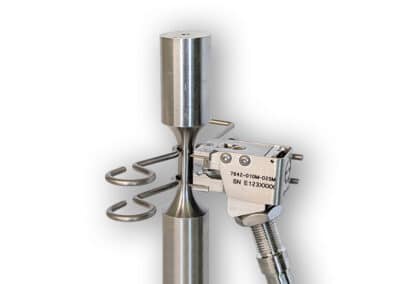
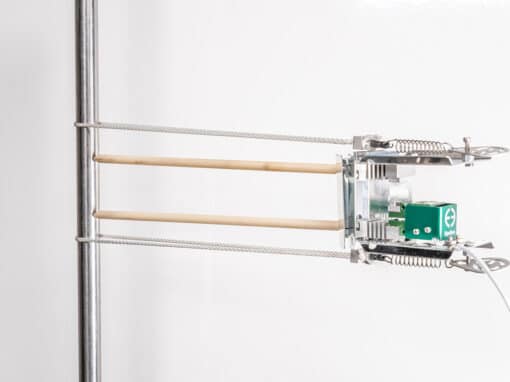
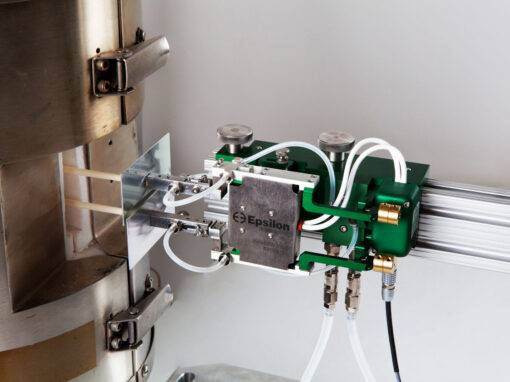
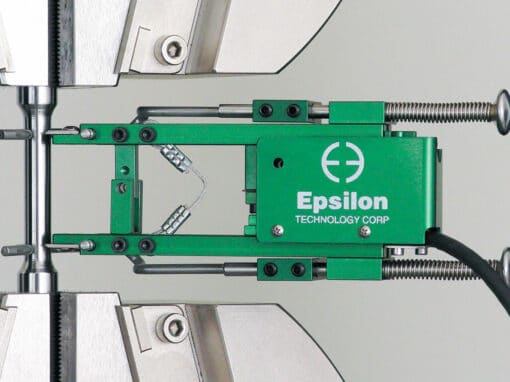
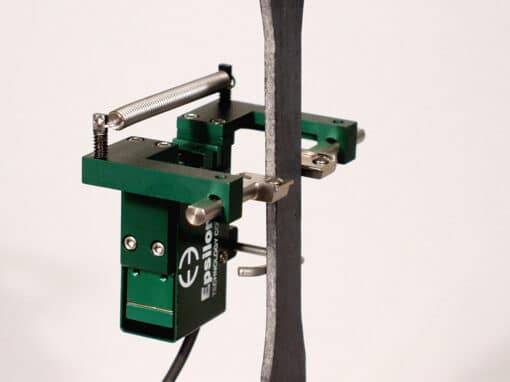
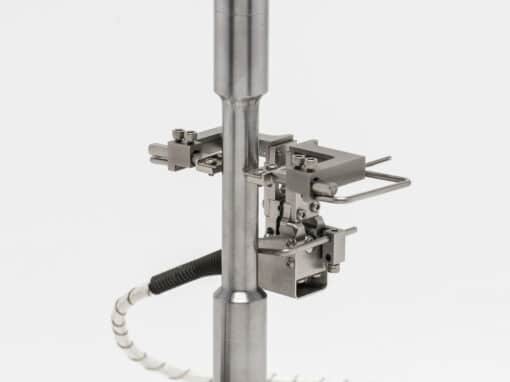
Model 7642 with 10 mm gauge length and +25%/-5% strain measuring range
-
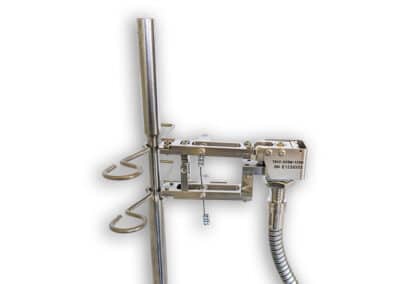
Model 7642 with 25 mm gauge length and +50%/-2% strain measuring range
-
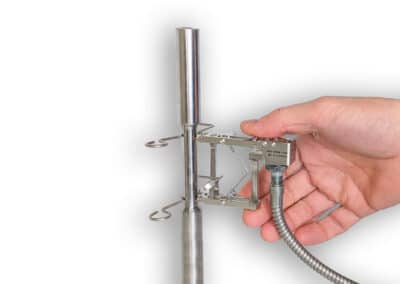
Model 7642 with 50 mm gauge length and +25%/-1% strain measuring range
-
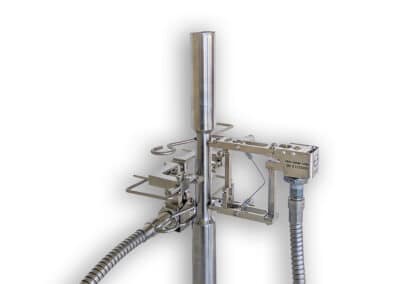
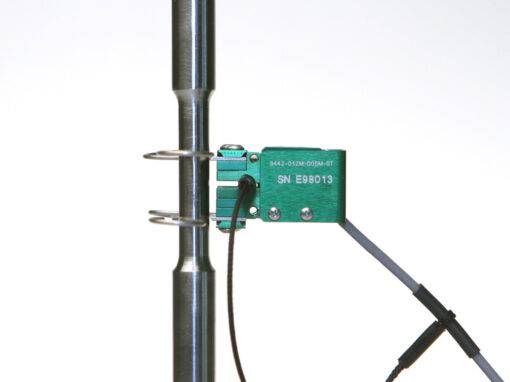
Models 7642 and 7675 may be used together to measure Poisson's ratio
-
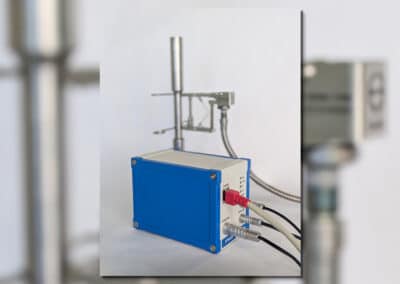
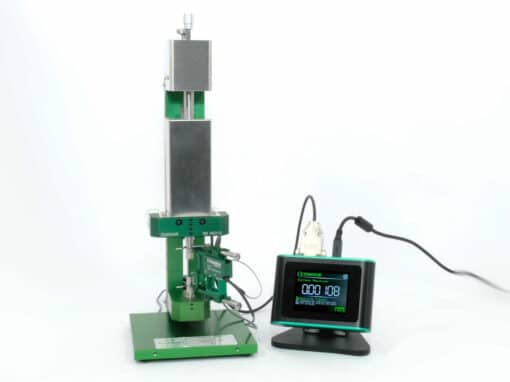
Model 7642's sensor controller
-
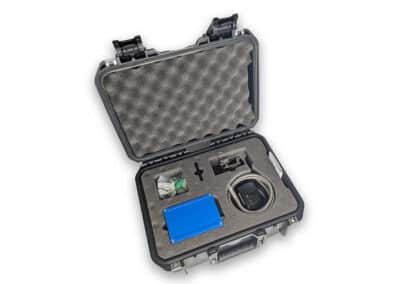
Storage case (model 7642 shown))
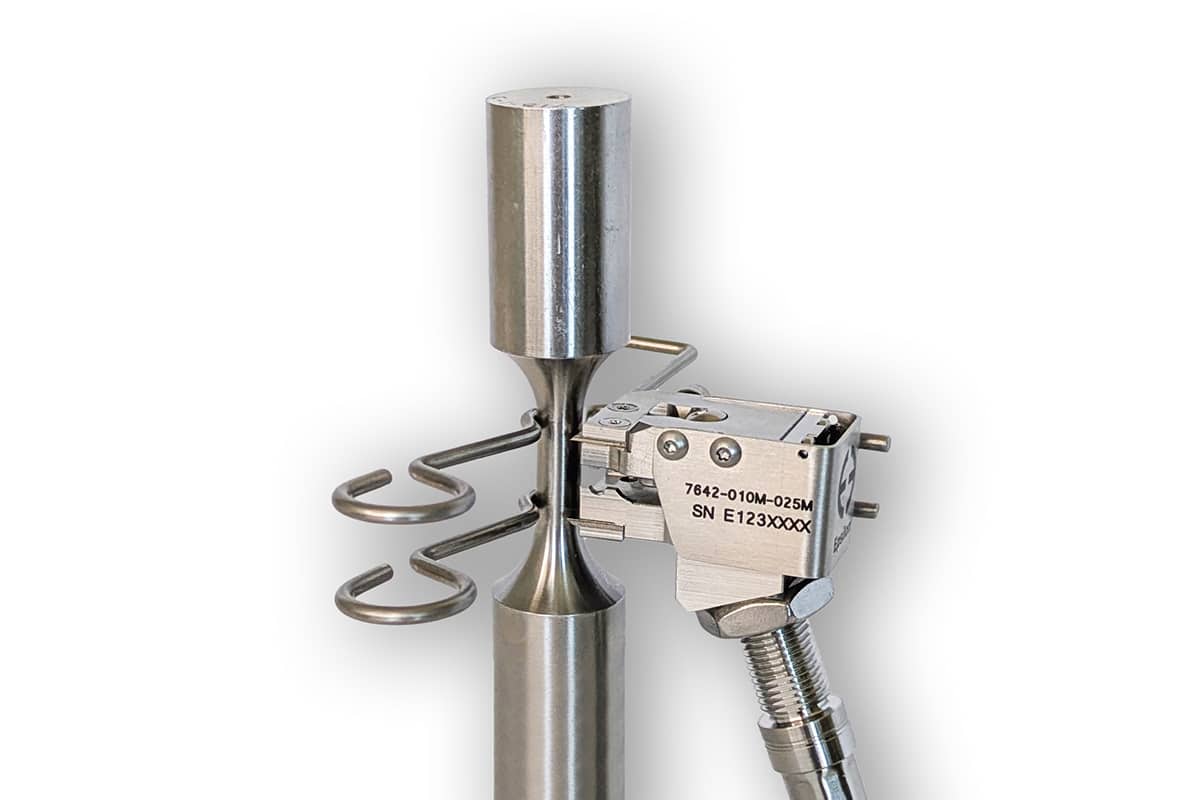


Ordering Information
Click table options to configure
-
pGauge Length
Selecting Extensometer Gauge Length
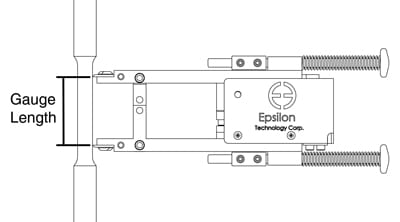
Extensometer Gauge Length is the distance between the extensometer’s initial measuring points on the specimen. If you are using a testing standard, check the standard for extensometer gauge length requirements. Many test standards specify the specimen dimensions and a matching extensometer gauge length.
Many specimens have a reduced section length that is designed to be greater than the extensometer’s gauge length.
| mm or inches | # |
|---|---|
| 10.0 mm | -010M |
| 12.0 mm | -012M |
| 12.5 mm | -0125M |
| 20.0 mm | -020M |
| 25.0 mm | -025M |
| 50.0 mm | -050M |
| 0.50 in | -0050 |
| 1.000 in | -0100 |
| 2.000 in | -0200 |
-
pMeasuring Range
Selecting Extensometer Measuring Range
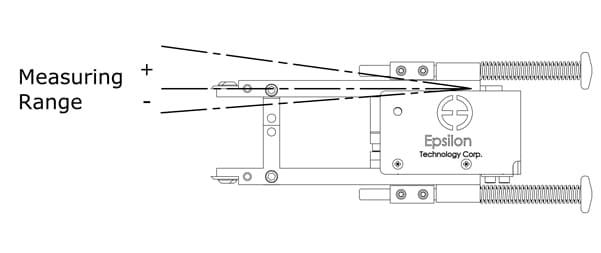
Measuring Range is the measuring capacity of the extensometer in tension (+) or compression (-) in units of % strain, maximum extension, or maximum deflection. When measuring range is in units of % strain, this means the maximum extension as a percentage of the gauge length.
Estimate the maximum strain or extension values you will need to measure, such as the total strain when the extensometer is removed after offset yield or the elongation at fracture. Then select a measuring range for the extensometer that meets or exceeds the requirements for the materials you are testing. If you are using a testing standard, also check the standard for extensometer requirements.
| extension | # |
|---|---|
| +2.5/-0.5 mm * | -025M |
| +7.5/-0.5 mm ** | -075M |
| +12.5/-0.5 mm ** | -125M |
| +0.10″/-0.02″ * | -010T |
| +0.30″/-0.02″ ** | -030T |
| +0.50″/-0.02″ ** | -050T |
Model Number: 7642 – _ _ _ _ – _ _ _ _
Selected Tensile Measuring Range: _ _ _ _
*tilted cable exit
**vertical cable exit; contact Epsilon for larger compression ranges
Example: 7642-025M-075M: 25.0 mm gauge length, +7.5/-0.5 mm measuring range
Related Models

Repairs/Service
If your unit is in need of service, calibration or repair, initiate the RMA process with us and we will be happy to assist.

Get Our Newsletter
Sign up for our newsletter to get the most up-to-date information on products and services.

Download Catalog
Our 2025 Extensometer Catalog, Version 111 is now available! Not finding something you’re looking for? Ask us about a custom quote.